Showing posts with label Hardware. Show all posts

Tuesday

The Best Photo Printer

How to Choose The Best Photo Printer
Have a nice printer, with good print results are of great importance to us who want it. For that we need to be careful in your choices.

Identifying the best photo printer can seem like an overwhelming task with the choices that are now available to consumers. However with a little planning and research individuals can find the right device for their needs.

There are several factors that an individual may need to consider before buying a photographic printing device. It is highly recommended by some experts that the person take the time to note what they are looking for in a piece of equipment. Different people have different needs. For instance, People who travel will have different needs from someone who is using this equipment for work related reasons.

Researching manufacturers may also be helpful. Some manufacturers will be known for making certain types of devices. For example, compact printers may be made by a manufacturer who is known for having the best portable printers for travel. While another manufacturer may specialize in printing devices for professionals.

Affordability is important for those who want to stay within a budget. Models can vary in price due to features, specifications, and various other reasons. Individuals who have a price range in mind and know what they want before they set out to buy a device may be able to find the deal that best suits them and their needs. It is also important to note that the more features the device has the more it may cost. Individuals will need to consider what features they need that are essential and then look for a device in their price range with those features.

Brands also will play a large role in a persons final decision. If a person is already using technology from a particular brand they may also decide buy the same brand for the printer. However, comparing two different brands may still be necessary if they are similar in price and features but have more specifications.

People may also want to consider how well known a particular brand is too. Popular brands have a proven track record for the types of equipment they manufacturer. Also it will be easier for the individual to find reviews of a particular model or brand by visiting online consumer sites where people provide insight into what they experienced with a piece of equipment they bought.

Features of a certain brand or model will vary for individuals. Depending on the types of situations the person plans on using the device, certain features may be more important than other such as Wi-Fi connectivity and how many pages the device prints per minute.

Most of these types of equipment will also include extra features such as memory card slots, extra displays for viewing pictures and other features. Depending on the model and type, these features may cost more than basic model brands.

With a little planning and comparing a person can find the best photo printer for their needs without going over their budget. The more information that a person can obtain on the device they want, the more likely they will be able to succeed in buying the printing device that meets or exceeds their expectations.

And do not forget, feedback from friends, family and other associates are also very necessary to assist us in determining who we will choose a printer.



Share/Bookmark

Thursday

The Best Computer Microphone

Sometimes abbreviated as mic, a microphone is a hardware peripheral originally invented by Emile Berliner in 1877 that allows computer users to input audio into their computers. To the right is a visual example of a USB headset from Logitech with a microphone. A popular solution for computer gaming.

There are quite a few top quality computer microphones available today but which one gives you the best value for your money? This article will look at the 3 best microphones on the market so you make a more informed decision before you part with your cash. This way you'll know that you'll be getting the best computer microphone to suit your needs.

USB mics have had a bit of a bad reputation in the past but recent technological advances have improved the quality of recording significantly. With these three mics you can now hear the clarity with minimal background noise to offer pro sound quality. User demands are varied and these three mics encompass every requirement from recording vocals and instruments to podcasts, speech and even VoIP.

So long as there is USB port on your PC, all three of these mics will work on both Windows and Mac. The issue of compatibility is nil for the users of these microphones. Not one of the microphones needs any extras to be installed so using them couldn't be easier.

The first one that comes to mind is the Blue Yeti mic, attractive and with professional sound quality. This is the universes 1st THX-certified USB microphone and uses Blue's proprietary three capsule science to make sure your sound is the nearest to studio-quality that's possible. The Yeti has a headphone input allowing you to monitor your recordings and also has controls that let the user adjust headphone levels, mute and microphone output gain enabling real-time recording control. For a range of sounds it has the option to choose 4 different polar patterns.Stereo mode uses both the left and right channels. Cardioid mode records sounds that are right in front of the mic. If you want to capture sound from every direction, the omnidirectional pattern is good for including ambient sounds. Bi-directional position records from the rear and front of the capsule.

It comes complete with an adjustable stand that allows freedom to change the direction of recording. For a complete bundle, the features are plentiful in a single microphone. Its old fashioned appearance gives it a "groovy" feel and it will look great at the side of your PC.

Another quality product comes courtesy of CAD and their amazing CAD U37 USB Studio Condenser Recording Microphone. This microphone permits budding engineers to record studio-quality audio straight into a computer smoothly. There is no software or driver to install so it is simply a case of plugging it in and starting recording straight away. If you're looking for rich and warm recordings, the large diaphragm mic is the one most often used for vocals and instruments. To reduce ambient noise and unpleasant background sounds, there is a bass "roll-off" button.

Other modes offer the feature to vary the sensitivity giving you the option to capture ambient sounds if you want. The generous 10-foot cable allows for maximum flexibility when choosing where to place it as having it next to your PC or laptop may not always be possible. Apart from the cheesy appearance of the CAD U37, this microphone does does it all and does it quite well. It has the ability to pick up the full texture of sound in a room in order to fully capture ambiance.

These 3 products fit 3 different price-ranges according to one's budget. Blue Microphone's Yeti is the most pricey out of the three but is surely worth it in terms of the features and sound quality. The CAD U37 Studio Condenser Recording mic and the Samson Go Compact mic both retail for around the same price and they are considerably cheaper than Blue's Yeti. Depending on the type of user, this is a very good value - the CAD or the Yeti for home recordings and the Samson being ideal for the type of user that is always on the move.

The Samson Go Compact USB Microphone is the last on the "best-buy" list. We hear that good things come in small packages and this wee mic follows that rule. It is custom built so that it can clip directly onto your laptop which means you can record on the go. It's really good for recording songs, podcasts and Skype should that application ever come along but the ability to capture sound in the field is superb. For different kinds of recording it features both the Cardioid and Omnidirectional pattern choices. The omnidirectional mode allows users to capture an entire room - ideal for impromptu band practice wherever. Since this mic still offers superior sound for such a small size makes this microphone a must for anybody who needs to record in different places.


Share/Bookmark

Upgrade Memory

Upgrade Memory
Upgrading your computer's memory can help to better facilitate your work. Whether you are a home user or an office professional you can really benefit from a computer with an enhanced memory. Your computer is embedded with two kinds of memory devices. One of these is used for short term applications whereas the other is used for long term data storage.

The memory device used for short term memory storage is known as RAM whereas long term data is stored in the hard disk. The RAM is only active when you are making use of the computer. The greater the capacity of the RAM chipset the faster your computer will be able to operate. Hence loading up on your Computer Memory can work wonders to facilitate your work and help you to accomplish tasks without any delays in the process.

When buying additional RAM chipsets you need to ensure that the Motherboard that you make use of is compatible with the type of memory that you will be buying. There are a number of Motherboards that produce slots for SDRAM and DDR Memory chipsets. Both of them cannot be used together however but it is always better to have the choice.

The different kinds of RAM work at various speeds. The Motherboard will support these speeds and for your computer to work at its best both the RAM and Motherboard must have a good speed and should be totally compatible with each other.

DDR Memory chipsets have however proven to be far more effective in terms of their memory capacity and speed. This is why they are steadily replacing SDRAM because they are relatively cheap and provide the user with increased efficiency. DDR chipsets are comes in a number of speed varieties such as the pc2100, pc2700 and pc3200.

The RAM memory works at different megahertz variety. The megahertz will however be restricted by the capacity of the Front Side Bus of your Motherboard. This is one of the things that you need to take into consideration because if your motherboard has a value lesser than that of your RAM, the capacity of your RAM will be limited by your Motherboard's capacity.

There is another important thing to consider when trying to optimize the speed of your Computer memory. If you make use of RAM chipsets of various speeds with your Motherboard, it will only detect the RAM chipset with the lowest memory. The rest of the fast memory will be dummied to the slower one. Hence it is important to make sure that you make the right choice.

When it comes to buying RAM you can easily do that through the internet. There are various web stores that will offer you a wide variety of options. You can check for the compatibility of your computer system with the online services that the web stores have to offer.

Share/Bookmark

Monday

UPS

UPS
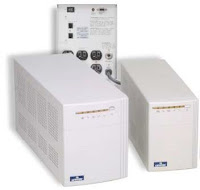
If you're having some strange problems with your computer, it could be that the power supplied to your machine from your wall outlet is dirty. Or perhaps you could been the recent victim of a power surge or spike during a hydro-blackout, or storm. Power surges occur, when too much hydro-is transmitted down the line even for just a nanosecond or so. It can often be caused by other electrical units connected to the same circuit. Sometimes a computer may not have enough power, due to a heavy draw from other items such as air conditioners.

Fortunately the solution to this problem. What you need is an uninterruptible power supply, commonly known as the UPS. This basically introduces a middleman/protector between your computer and the Hydro coming from your wall socket. The UPS plugs into the wall and draws energy to charge a battery. The power from the battery, as I use the power your computer. By adding this extra step, power surges, power sides and blackouts will have little effect on your computer. When the power goes out, the batteries on the UPS takeover and continue to supply power to your computer.

Depending on the size of your batteries, you be able to continue using your computer for several minutes to several hours. Hopefully this gives the power problem enough time to correct itself. Generally speaking the price of a UPS goes up with the size of the battery inside. At the very least, having only a small battery will at least give you the time to save everything you're working on, and powerdown your computer systematically, and safely.

There are a few different types of power supplies you should consider. One type of uninterruptible power supply, is called the same by UPS. The other type of uninterruptible power supply, is called a continuous UPS. Both UPS types share some similarity. They both remain plugged into your standard Hydro, and charge a set of internal batteries. A standby UPS, will only switch to battery power, for your computer, whether it detects a power surge, or a power blackout.

The stand by UPS can switch the battery power very quickly, in only a few milliseconds. With a continuous UPS, your computer is always running from the battery. The UPS is constantly charging the battery with power from your standard Hydro. If the power goes out, there is no need for the UPS to switch to battery, and there is no delay of power supplied to your computer.

Share/Bookmark

Sunday

Keyboarding Introduction

Keyboard
Many, if not most of us, spend a significant amount of time in front of a keyboard. Some of us rely on our typing skills (to one degree or another) to generate a living. And while point and click technology has made speed typing less of a requirement than it was a few decades ago, good communication increasingly demands solid typing skills.

A computer keyboard may seem like a simple and relatively unimportant tool, but the reality is that the keyboard interface has allowed information to be created and replicated in a way that has transformed the world. Think about it. What would a computer be without a keyboard? Certainly, the mouse and other innovations have reduced keystrokes. But there is simply no shortcut to entering vast quantities of raw information into a computer system. And like it or not, virtually every sentence, every word, every syllable, and every letter has had to be pounded out by a typist. It turns out that the lowly keyboard is one of the most important tools mankind has ever devised.

Standardized Keyboard Arrangement: The Key to Typing Productivity

The standard keyboard arrangement in Western countries is often referred to as QWERTY. Take a look at the top row of letters on a standard keyboard - moving from left to right - and you will understand why. All keyboards have a common placement of letters to ensure that any skilled typist can move seamlessly from one keyboard to another without losing anything in productivity. The current computer keyboard configuration may not seem all that intuitive at first glance, but it is elegantly designed to result in maximum typing speed and efficiency.

Most standard keyboards manufactured today have 101 keys. Increasingly, additional symbols and specialized applications are generating a lot of keyboard variations. However, the fundamental arrangement of the standard letters and numbers is generally never changed. This allows individuals to move from one keyboard to another without trying to figure out a new keyboard arrangement every time they type. Over time key positioning can be memorized and fingers can be trained to type keys without searching or even looking down at the keyboard. This is much the same concept as we see with the piano keyboard. Piano keys are arranged in a standard fashion, allowing play by touch rather than by sight. Of course, like sight reading on a piano, touch typing on a keyboard requires a lot of practice. With dedication, however, typing can become second nature and speed and efficiency can increase dramatically.

Share/Bookmark

Saturday

Computer Hard Drive

Hard Drive
Curiosity, it is said, killed the cat. Many people are curious as to the inner workings of their hard drives and to date, no people have died due to this curiosity, although quite a few hard drives have suffered fatal injuries. The implications of this is put into perspective when you consider that the best way to learn how a hard drive works and therefore eliminate your fear of damaging said hard drive is to take it apart and look inside. Then, consider that opening a hard drive ruins it and it is not fixable once you have opened it. Therefore, if you must explore the inner workings of your hard drive in order to feel as one with your computer, choose to open a defunct hard drive or purchase one from a second hand computer store. Do not attempt to take apart the hard drive you intend to use on your computer as it will not be able to work after the deed is done.

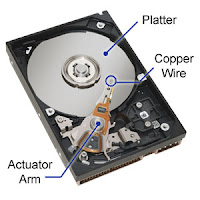
Hard drives are actually quite small and are contained in sealed aluminum boxes. On one side, there is a panel of electronics that detaches from the rest of the hard drive. These electronics control the read and write functions as well as the motor that spins the platters, which we will get into in a bit. It is the job of the electronics to turn the magnetic domains into bytes for reading and to return those bytes into magnetic domains for writing.

If you look under the board of electronics, you'll find the connections for the motor and a vent hole. The purpose of the vent hole is to equalize pressure from internal and external air sources to keep things running smoothly and to release heat that is built up during the running of the hard drive.

You will also find the mirror like platters, which spin at speeds up to 7,200 rpm when the drive is operating and the arm, which holds the read and write heads. Most computers, with the intent of increasing the amount of data the drive can store, have more than one platter and more than one head. Usually, the number of platters is doubled in the number of read and write heads held by the arm. In other words, if a computer has three platters, then it will most likely have six read and write heads, or arms.

As can be expected, the arm must move at an extremely rapid pace and be exactly precise in its movement. For this reason, the motor for the arm is constructed using a high speed linear motor. Not all computers use the same motor, though, for this purpose. Some use voice coil, which is a technique commonly seen and used to move the cone of speakers in a stereo.

Data is stored on the surface of each platter. The pattern looks similar to a pie as a computer uses sectors and tracks to store information. Tracks have a concentric shape while sectors look like pie wedges. Sectors are also finite in the number of bytes each can store, which is typically either 256 or 512 bytes and are therefore often stored in clusters on the platter.

Now that you know the inner components of your computer's hard drive, perhaps your curiosity will be sated, thus saving your hard drive from any harm. Each component of the hard drive works in tandem with every other part to deliver a high performing and speedy work environment for you, the computer's user. While fragile in nature considering the response of a hard drive to being dismantled for observation, most users can expect a hard drive to last for many years before needing to be replaced. The hard drive is not a mysterious part of your computer, but rather the central intelligence of your computer and its capabilities based on what you tell it to store for you.

Share/Bookmark

Friday

Secrets of Your Computer & Motherboard

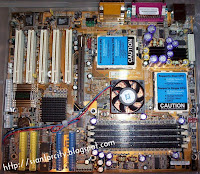
MotherboardWhile not science fiction, the motherboard in your computer does have some similarities with the idea of a mother ship in old science fiction movies. The motherboard is the one piece of equipment in your computer that ties everything else together in a workable manner. It is the piece of the computer that allows all other computer components to receive power and to communicate with one another to deliver the desired result when you give the computer a command.

Motherboards have developed over the past twenty years from where they started when first created. Back then, the motherboard held little in the way of components. Floppy drive controllers and memory slots comprised just about all that a motherboard held. Now, motherboards boast a variety of features that have been built in and directly affect the capability of your computer to be upgraded. This capability is mandatory when considering the speed at which operating systems change and evolve as end users require more from the desktop and laptop computers.

The main purpose of the motherboard is to hold the computer's microprocessor chip and then direct everything else connect to that chip. Everything that runs on your computer is either part of the motherboard or it plugs into the motherboard to be routed to the chip in order for it to be able to run.

The form factor, which is the shape and layout of the motherboard, affects where the components of your computer go and the shape of the computer's case. Most motherboards use some form of standard form factors in order to fit into standard cases in computer models today.

While the form factor is important to the motherboard, it isn't the only thing that controls how your computer works with the motherboard. The type of central processor your computer uses is determined by the socket for the microprocessor on the motherboard. The chipset, which is part of the logic system on a motherboard, connect the central processing unit to the rest of the computer. The BIOS chip controls the most basic checks on the computer every time you turn it on and does so from the motherboard. The real time clock chip maintains these basic settings and the time for the system.

Motherboards also contain slots for PCI, AGP, IDE, firewires, USB, and memory slots. Every one of these items requires a working motherboard in order to get power to run as expected by the end user. Each of these slots are necessary for computer operations to function in today's world of internet and business applications. Without these vital functions built into the motherboard, the average user could not conduct meaningful business in the competitive aspect of today's society.

New technologies are being added to motherboards all the time. They are not scary pieces of equipment to be avoided, but rather an integral part of your computer that enhances your computer using experience. It can be upgraded to fit your needs with little trouble and operates on a constant basis to deliver what you expect in your computer.

Share/Bookmark

Sunday

Best Printers Before You Buy

best printerWhen looking for the best printer you should probably go for a laser printer as these have many more advantages over the old ink jet or dot matrix printers.
The main reason why laser printers are the best printers to buy is due to the stunning clarity of the images and text that you are printing and the speed at which this happens. When researching printers and faxes it is helpful to know that the speediest black and white printers can print more than 200 pages per minute or 12,000 pages per hour, with the color laser printer scanner coming a little bit behind with over 100 pages per minute or 6000 pages per hour.
Most of the best printers on the market now always print on A4 size paper, but if you want to be able to print on different size paper you should check that it has this feature. You can get a specific A3 laser printer if that is all you will ever print but I think it would be wise to get one that does all sizes.

The laser process is achieved by using a printing process called xerographic which basically means a laser beam is used to scan the image or text and uses that scanned image, which is very accurate and prints it onto paper.

Some main features that you may want to look out for.

Monochrome or Colour?
Do you want to print in black and white or colour? I know it may sound a silly question, but there are different printers that will do either with the black and white models being significantly cheaper at the printer sale which may be what attracted you, so make sure you look at the spec as it is not always obvious on the packaging.

Long Lasting Toner Cartridges - Check that the cartridges have a good life span. The life span of an average cartridge is about 1,500 prints but this can vary with the model. Either way there should be a warning light to advise you when it needs to be changed.
Minimal Wait times between Prints - If it's a laser printer scanner that you want look out for one that has a fast modem speed (min 33.6 kbps), so that you documents are processed fast. This will mean that you will not be left hanging around waiting.

Network Printers - If it's a network printer that you are after look out for the ones that have wireless capability. As these allow you to connect the whole office to the printer very easily using a USB Ethernet connection.


Share/Bookmark

Saturday

Motherboard Repair

motherboardA question that regularly crops up on the internet is that of how to repair motherboards. The types of questions generated on the various forums and e-mails indicate that the problems arise in computers of all leading brands and also unbranded ones. There are innumerable methods of repair suggested on the internet. Most of the repairs of bad motherboards follow the method of trial and error and are not very reliable in terms of results. The decision to repair a motherboard is not for the week at heart. It can be time consuming and risky. It can take considerable time and, due to the fragile parts, you could break something. If you bend a motherboard to much it can crack or break making it useless.

Computers show the effects of usage by how slow they work. One cause is the amount of dust that collects on the motherboard. This dust affects the working of the Motherboard and can make them overheat and fail. One step to motherboard repair is to remove the dust. This can be done by using a small vacuum cleaner or canned air to remove the dust as much as possible.

With motherboard problems It is very important to know the components that make up the motherboard before ever venturing to repair a bad motherboard. The motherboard is the main board that contains the central circuit board of the computer. All other components and peripherals are plugged in or connected to the motherboard. One of the main functions of the motherboard is to relay information between them. The motherboard houses the BIOS (Basic Input/Output System) which is simple software run by the computer designed to function when the computer is switched on.

To repair motherboards you should know that Chipsets in the motherboards are those that form an interface between two main parts of the computer, the front side bus and the peripheral buses or the main memory. There are some memory chips that are extremely non volatile and it contains the firmware of the system or what is popularly known as the BIOS. Motherboards also contain a clock generator which is responsible to produce the system clock signal that can help in synchronizing various components. The cause of a bad motherboards could be in any of the components. It is best that the job is assigned to an experienced and technically qualified person or a reputable dealer or the manufacturer of the board.

It is mostly better if you replace the bad motherboards with a new one. It is extremely expensive to repair an old motherboards. You should compare the price of repair to the purchase of a new computer.

Share/Bookmark

Friday

How to Choose a Photo Printer

How to Choose a Photo PrinterPhoto Printers are printing machines that are like other common printers specially manufactured for printing photographs. Having a photo printer at home is a joyful thing wherein you can cherish your memorable moments and share the same pleasure with your lovable ones.

The leading camera producing companies like Canon, Olympus, Sony and Kodak along with world known computer manufacturer like Hewlett- Packard to mention a few have designed so many Photo Printers that are highly recommendable.

The two basic types of Photo Printers are:

Inkjet Photo Printers: This type is a multipurpose machine that can also be used for taking out colour print outs and other Black&White documents.

Dye-Sublimation Photo Printers: As an inkjet photo printer prints with the ink a dye sublimation photo printer prints using ribbons called as dye-sub ribbons. These types of printers are exclusive for photo printing.

So it is the buyer's preference to choose any of the type according to his need. If he prefers using a printer solely for photo printing a dye-sublimation photo printer should suit him well.

There are both high and low end varieties of both the types of printers which have a considerable amount of price difference. The high priced printers give very good picture quality and high resolution compared to that of the low end printers.

Few basic guidelines:

* Enquire the expenditure of consumables like Ink Cartridges or Ribbons before choosing a printer as few printers give very good picture quality but very low number of copies which may be very costlier.
* Look for the maximum size of the print out that can be taken from a printer as few printers may not give print outs of the size that is needed by you.
* Ask for the Software that comes with the printer for photo editing, enhancing and resizing of the photographs.
* Always buy Photo Papers and ink that are manufactured by the printer company itself and never go for cheaper price that are inferior in quality as that will mar the quality of the picture.

Follow the printer's manual book for a long life of your printer.

Enjoy Photography and Printing!

Share/Bookmark

Wednesday

Sound Card Be One of Your Computer

Sound Card For a large number of computer users, and even some gamers, having a sound card added to the rest of their computer components is seen as a luxury rather than a need. And though there is some legitimacy to this attitude, the fact is that a good sound card can actually benefit your computer's performance on a fundamental level. Many programs are prepackaged with a variety of sound features - all of which must be processed in the same manner as any other computer data. If your array of computer components does not include a sound card, that sound will end up being processed by your main processor - which can slow down your computer and weaken its performance.

The fact is that sound cards can speed up the loading and performance of any program or file that contains an audio line, and no computer should be without one if it can at all be helped. Of course, if you purchase a system intact these days, an alarming number of them are being brought to market without a good card included as one of the essential computer components.

When you are looking for the best sound cards, there are a number of aspects that you need to compare. Among these are the maximum sampling rate, the signal to noise ration, and the digital to analog and analog to digital conversion rate. The maximum sampling rate is the purest indicator of how effectively the sound card produces the digital sound. The key to identifying a quality sound card is to find one that can process enough analog sound data to successfully relay the digital sound after the conversion process.

With respect to the signal to noise ratio - that is merely an indicator of the amount of noise the sound card adds to the original signal. That and the digital to analog or analog to digital conversion rate will tell you how fast the audio signal can be converted, and how well the quality of the original signal will be maintained without extraneous noise.


Share/Bookmark

Monday

RAM For Your Computer

Most computer users have heard of Random Access Memory (RAM), and many have some vague idea of its role in ensuring the smooth operation of your personal computer. Among your many computer components, RAM is one of the most critical as it has the important task of storing information and making it available for other computer components to utilize. Whereas your hard disk drive stores large amounts of information for the long term, RAM operates on a more focused, short-term scale, maintaining information in a holding pattern of sorts so that it can be accessed quickly by the various programs and documents that you run.

When choosing RAM for your computer, you will quickly find that it is one of those computer components with an incredible array of choices. Determining which of the many options available o you will require you to evaluate a number of your computer needs, and choose based on several factors.

For instance, how much RAM do you need to perform the functions you need? And in what format do you want to buy that RAM? The needs for RAM have grown in the last decade, as the memory needs of our computers have grown to accommodate new, memory-intensive operating systems, programs, and games. And determining how much RAM you need (1 Gigabyte? 2 Gigabytes?) and in what size (One 1 Gigabyte stick or 4 256 Megabyte sticks?) is more a function of art than science - what works best is dependent upon the operating system and programs you use.

Remember that, as a general rule, larger amounts of memory permit more data to be stored, which in turn allows for faster PC activity. Of course, if your processor and buss cannot get the data to the RAM as fast as it can channel it to the other computer components, it will all be for naught anyway - so check the specifications of your motherboard prior to purchasing new RAM for your computer.


Share/Bookmark

Friday

Blade Servers About

computer & technologyWhat are the Blade servers?
Thin servers, exchange hot, fit in a single chassis like books on a shelf - and each is a separate server, with its own processors, memory, storage, network controllers, operating system and applications. Blade server simply slides back inside a compartment on the chassis and fits into a half-plate connections or later, sharing power, fans, floppy drives, switches, and gateways to other Blade servers.

The advantages of the boarding Blade will be evident to anyone with the task of moving hundreds of pots and cables through racks just to add and remove servers. With switches and power units shared, precious space is being waged - and Blade servers enable higher density with far greater ease.

Affordable Density
With a large number of blades of high-performance server in a single chassis, Blade technology reaches high levels of density. Further expansion is possible via optional modules: the performance and density are balanced, leveraging the infrastructure for optimal utilization. And all this performance and density are extremely cost effective. The increased density means fewer racks. Fewer components are duplicated.The number of cables is reduced dramatically, in some cases, the switches and power distribution units are also in smaller amounts. Fewer components contributing to a total of lesser items that may have bugs or need repairs, and modular scalability helps distribute the costs of capital equipment over time. Many of the expenses of daily life - energy needs and cooling, hours of assembly and installation, square footage of physical space - are designed so that it can be reduced with the architecture Blade.

Easy maintenance
All critical components of a Blade server can be transformed into redundant, hot exchange, including: cooling systems, power supply, controllers and Ethernet switches, hard disk drives and processors. Remove a server for maintenance is as simple as sliding the Blade outward from the chassis, which is as simple as removing a hotswap HDD from a server.

The advanced Blade servers offer intelligent ways of obtaining maintenance of high sensitivity.
Some of the components of the Blade servers can alert a systems management processor hours or even days before failure occurs. Advanced diagnostics run directly on the server allowing a quick and efficient restoration. Some Blade servers can even be designed so you do not have a single point of failure.

Modular Scalability
Blade servers are revolutionaries because it climb upwards but not outward.Adding a new blade only mean that you have to slide a blade in the chassis or a module in the modules slot into the chassis. The modular design technology of Blade makes scalability has the speed of lightning.

Availability flexible
Blade technology is designed to eliminate the limitations imposed by the old conventional design for servers, in which each server could accommodate only one type of processor. Each Blade in a chassis is actually a self-contained server, running its own operating system and software. The Blade Chassis can carry a mix of blades, with different speeds and types of processors. And this technology are developing rapidly offer real protection to investments for the future.

Ramifications techniques
Benefits are immediate, tangible, making technology Server Blade an important contribution to a revolution in progress aimed at computing on demand. Taken together with other rapidly emerging technologies (grid computing, autonomic computing, Web services, distributed computing, etc.).,

Who Offer the Best Blades?

There are no perfect blades offering in the market today, its all about your needs & which blade offering fit your needs. Though reading how these blades offering compare can help you identify the blade offering which fit your needs the most. Check out the following comparisons to find out the Blade for you :
http://itcomparison.com/Blades/Bladesdellvshp/Bladeshpvsdell.htm
http://itcomparison.com/Blades/Bladesibmvssun/Bladesibmvssun.htm

Share/Bookmark

Monday

Servers : Racks, Blades and Towers

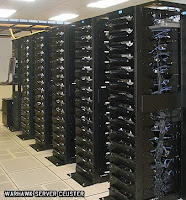
computer & technologyUnlike tower servers, offices that use rack servers which traditionally come in 1U, 2U, 3U, 4U or 6U are installed in racks. The numbers that give names to the rack mounted servers precisely indicate the number of Us they occupy in the racks. The 1U server occupy a single 1U bay, the 2U occupy two and the 4U occupy four, while a rack of standard size has up to 42U:

The servers in 1U format are preferred by companies for use in hosting and data, because they are very compact (only 4.4 cm high), which lets you install a large number of servers per rack. The main limitations of this format is the limitations with regard to ventilation (due to the small inner space), impeding the use of processors with high energy consumption and the need to use coolers and special fans, which all run at an extra cost. Besides the basic components, spare space in general to install 2 or 4 hard drives of 3.5 "(according to the provision of other components) and a single expansion card, installed horizontally, with the help of a Riser.

Then there are the 2U servers. They use "normal" power sources and coolers and therefore end up being a little cheaper. The bigger internal space makes the format more suitable for 2U servers with two or more processors, or processors that use high consumption. The height is not enough to install expansion cards upright, as in tower servers, but you can use a Riser (as in the case of 1U), or use half-height cards (the lower plates, which have half the height of normal plates).

Finally, we have the biggest servers, which use 3U or 4U. There are 6U servers, but they are rare: this format is typically used by the disk arrays and chassis for blade servers (see the topic below). Using a 3U server or larger completely eliminates the problems with space, allowing the expansion cards to be fit in vertically and a large number of removable hard drives installed in bays, but causes the server to occupy more space in the rack, which increases the cost to the host of the datacenter, where you would pay an extra fee per pen used.

Another format that is becoming increasingly popular are the blade servers (blade comes from the word "blade", indicating the small format), an ingenious idea to further increase the density of servers and allow the sharing of common components in the datacenter, as power supplies and optical disks.

The idea is that instead of having 10 1U servers, with 10 sources (or 20, if sources were used redundant), 20 network cables (each server typically uses two cables, one for the network and another for management or redundancy), as well as power cables, cables used by KVM and so on, you can use a single Chassis, with an equivalent number of blade servers.

Each blade is a complete server with its independent processor, memory, network card and disks. Its small size, the blade servers typically use low-power processors and hard drives of 2.5". At the beginning, it was the common use of processors from Transmeta and VIA, but they ended up being almost completely replaced by Intel & AMD multiple cores processors which are much faster, but still relatively economics. In the case of hard drives, the disks of 2.5 "are favorites for providing lower access times (but lose with respect to transfer rate), in addition to electric consumption.

Share/Bookmark

Sunday

Fix Your Slow Computer With Hardware Upgrades

computer & technologyAs you install and run more software on your computer, over time, the computer will start to run more slowly. This happens because the additional software is making greater demands from your hardware. You can address the problem by either reducing the software or increasing your hardware resources.

If you decide to upgrade your hardware, there are 3 parts of your computer that can be upgraded to improve your PC speed: the RAM memory, your disk drive and the CPU+motherboard combo.

Upgrading your RAM or a disk drive is easy and you can do it yourself, in a few simple steps. Upgrading your CPU is difficult and involves replacing the whole motherboard. I would not recommend upgrading your CPU, yourself, unless you know what you are doing.

Upgrading your RAM

Dollar for dollar, increasing your PC's RAM is the best value for money upgrade you can perform. Right now I would recommend having 1 Gig of RAM for low end machines, 2Gig for middle of the road machines and 3 Gig for high end computers. You are unlikely to benefit from having more than 3 Gig.

You can tell how much RAM you currently have installed, in Windows XP and Vista, by opening the control panel and going into the system section.

There are a number of different types of RAM and they operate at different speeds. RAM speed is measured in MHz. The type of RAM and the speed that is allowed is determined by your motherboard. You can look up the type and speed of RAM you can use in your motherboard manual. I recommend getting the highest speed RAM allowed.

Open the computer tower and locate the RAM slots there could be 2-4 slots, if you don't see them check your motherboard manual. After locating the nearest available Slot simply insert the new module into the slot, taking careful note of the groves on the DIMM and the Locking clip to position the Module properly. If the DIMM does not fit you probably have it positioned incorrectly so flip it around and try reinserting it. Once the RAM module is in place apply pressure to the locking clips to secure it, you should hear a click as they close on the DIMM. Then just re-start your PC, go to the control panel and open the system section to ensure your computer has detected the new DIMM and it is working correctly.

Upgrading your hard drive

Hard drive speed is measured in RPM, that is the number of times the hard drive rotates in one minute. I recommend buying a 7,200 RPM hard drive. Before purchasing a new hard drive consult your motherboard guide to find out what type of hard drives are supported. If your motherboard supports SATA drives, buy one of those.

Once you have purchased your new hard drive it is time to prepare for the install. First install any software that came with your drive. Then power down the computer and open the case.

Setting jumpers (This is only for IDE hard drives):

The different jumper settings will be shown on a diagram on top of the hard drive. If you have one drive that drive should be set to the single drive mode. If you have multiple drives, the one drive needs to be set to master and the rest of them to the slave mode.

Insert your new drive in an open drive bay. These bays are generally located in the front of the tower. Fix the drive in place with screws.

Look at both your mother board and drive manual and connect the drive using the relevant IDE or SATA cables.

Now that the hard work is done the only thing left to do is close back up your system, plug it in, and turn it on to verify that the new hard drive is working properly.

Share/Bookmark

Thursday

USB Ports For Your Computer

There was a time when the old serial ports ruled the day when it came to connecting our computers to important computer components such as the mouse, keyboard, and printers. With today's technology, however, the serial port has given way to the USB port, and almost every peripheral accessory is now designed to connect to your personal computer or laptop via USB access.

While laptop computers generally come with only two or three USB ports, desktop computers can come with as many as six - or more if you custom design the system yourself. Determining how many USB ports you need is really a matter of figuring out how you use your computer. If you use it primarily for document processing and internet/email access, two or three ports should suffice. If, on the other hand, you utilize your computer with a printer, scanner, webcam, speakers, and a host of peripheral computer components, a PC with six or more USB ports would better serve your needs.

In listing just a few of the computer components that rely upon USB technology to connect to your computer system, it is clear to see how prevalent the USB technology has become. Newer keyboard and mouse technology is almost exclusively geared toward USB, as are many of the newest printers. Printers, which were once connected solely through a PC's parallel ports, have seen speed and performance improve dramatically since they began relying upon USB.

In addition, computer components like webcams, scanners, external hard drives, and USB flash drives all require USB ports to join your computer family. If you have a system that only provides two or three USB ports, you have several options - you can either switch the various computer components around as you need them, purchase an additional USB card for your motherboard, or utilize a USB hub that will offer up to four additional USB slots.


Share/Bookmark

Wednesday

Find Out the Best Motherboard For Your Computer System

computer & technologyJust as any mother is the best to nourish and knows how to take the complete care of her baby; in a computer device the motherboard plays the just right role of supplying the necessary components for the perfect functioning of the system. Since motherboard is the most important circuit board of any computer you need to know how to find out the best motherboard for your system.

Some good motherboards

When you are going to buy the best motherboard for your system price is very vital. You can choose either the board with great graphics or you can prefer concrete functioning rather than graphics quality. When the priority is the great performance of the motherboard with satisfactory graphics, the Asus motherboard of the 'M2A-VM' is good also available at the affordable price of seventy dollars. With this you have the opportunity of using the good quality AMD processor though not the most recent AM2+. From this board you can get the six aboard channel audio, DDR2-800 till 8GB, ten USB ports, and incorporated ATI Radeon can give consent to twin monitors.

For AMD motherboards, Asus won't dishearten you as they always keep the promise of the best performance for the high quality graphics card; memory as well as CPU is fast. And for such good performance you can get 'Asus M3A32-MVP Deluxe'. The 220 dollars priced board has compact features of double PCI-E slots, six PCI-E x1 ports, ten USB ports, DDR2-1066 of up to 8 gigabytes, HD audio and many more. When you are looking for motherboards for some lesser price around 180 dollars 'Gigabyte GA-MA790FX-DS5' is also wonderful. The features found are six USB ports, two PCI-E slots, DDR2 1066 of up to sixteen gigabytes, six USB ports, and also six SATA ports.

For the best motherboard the 'Asus Maximus Extreme' is a great choice when you are willing to pay the high price for motherboard. The functioning of the powerful CPUs from Intel is greatly supported by the motherboard from Asus. It has the features of SLI, processors of Intel Extreme, six USB ports, 8GB of DDR2-1333 and six connections for SATA. Other proficient motherboards are of Gigabyte Model GA-G31M-S2L at 65 dollars or less, the Gigabyte GA-X38-DQ6 for at 199 dollars, Biostar TForce TF7050-M2 available for 80 dollars and apart from these you can easily find lots more varieties of motherboards when you are searching for the motherboards on the internet.

What should you look for in your motherboard?

The main elements that make up the motherboard are the CPU or the processor, the socket for the motherboard, bus speed, chipset, system memory, bus speed, peripherals like printer, keyboard, mouse etc and you must get the motherboard which is compatible for supporting all the components well. So selecting the best motherboard can be a perplexing task. So it is better to get the proper ideas about the different motherboards and read about the reviews which can be a good guide for buying.

Share/Bookmark

The Best Speaker For You

computer & technologyA computer without speaker is like the delicious dish without the toppings. There are many companies which manufacture speakers but according to the critics and users of the systems not all are as good as desired. And the speakers which come from start with the computers are of standard quality. For this reason many people wish to buy some good sound system individually.

Facts to be considered while getting the best speaker for you

The points that act as the deciding factor for which one is the best speaker for you are many. You will have to think the purpose for which you are buying the speaker. You may require the system for some normal usage as habit or you may want some high quality performance for the movies or playing games in computer. The two common types for speakers available are the 2.1, for the average usage which will cost between $20 to $90 as well as 5.1, for gaming and watching movies which will cost among $40 to $200. if you want more then you can go for the profuse 7.1 surround system.

The good esteemed speakers those will please you

After you are ready with your choice of the type of stereo system for the computer you can now start looking for the system that has good preferences in the market. It is not always possible to select the best among so many options present round the world. If you are looking for the best speaker of type 2.1 then 'Logitech Z-2300' can be considered the best. And for type 5.1 'Z-5500' from Logitech can be take into account as the best bet. 'M-Audio Studiophile AV 40' is also good if you wish a great system for games or viewing movies. If you are searching a system at some lesser budget then at around $40 you can buy Altec Lansing VS2321 for 2.1 categories.

Logitech Z-2300

My vote will go to the Logitech Z-2300, available at around $90, due to model design and also for the wonderful eminence of the audio. The sound or bass or price all aspects have been taken full care of. You may say that the subwoofer is big or there is limited control for treble or the remote is still wired but such flaws can be easily overlooked. You will get a remote control along with the system which will help you in the management of the system for volume tone. The black and chrome combination of color gives the case of the sound system gives a good appearance. It won't dissatisfy you with the sound that is given out from the sound box when you are watching the favorite DVDs or listening to soulful music or even when you are playing games. The adapter for video games will allow you using for console gaming devices. This system can aptly suit your stereo needs and even you can present it to your near ones as gift.

Share/Bookmark

Sunday

RAM ( Random Access Memory )

computer & technologyRAM is separated into short blocks of information, every of which can be gotten by an exceptional number, known as an address. In instance, every address sends sixteen bits of information, and there are the 4096 addresses, to provide 16*4096=65535 bits of information, or eight KB (Kilobytes). The majority of PCs now have at least eight MB (Megabytes) of RAM, and sixteen or thirty-two MB (Megabytes) is favored.

The RAM space and place on PC

The majority of PCs come outfitted with 512 MB of RAM by now on PC. More RAM can be inserted in the machine at will. However, there is generally a control located upon only how much maximum RAM can be installed more to a PC system. The RAM is not arbitrary, as its name would guide one to consider. RAM is very restricted and the storing capacity can be straight determined.

Type of RAM

RAM is what is identified as separate microchips that mean it is divide. Another type of RAM is a unit that connects into slots in motherboard of PC. A system of electrical trails to the CPU enables the link to flash for RAM.

Why is RAM Essential?

RAM refers to an essential purpose of recovering data, which should be retained in a fast mode. This action is the same to a person's brain's utility in regaining essential information from short-term memory. Open documents and the use of programs on PC systems needed the support of RAM. Clients that play several of moving games with full images or keep several of databases open when on their PC will require the utilization of extra RAM. This will enable them to superior access data they want while the time reaches. The RAM is supported onto a short time; however it enables data on to arise rapidly and devoid of much commotion on the issue of the PC user.

How RAM Works

Without getting so technological with RAM, it is a sequence of memory packets, which hold an indict of electricity. With indict each packet symbolizes a one and without zero. The earlier the form can be moved through quicker information can be utilized. Obviously, the bigger cell the more information can be transmitted through. It is probable to get sooner RAM and certain systems work superior with the same shapes of RAM chip mounted.

You can improve the RAM on each system thus if you have desktop PC or notebook PC that is all right with you getting more. The mainly essential thing is to confirm that you have got free outlets that you can mount memory chip in to. When buying new RAM for the machine you should always do proper research.

Share/Bookmark

What to Look For in the Best External Hard Drive

computer & technologyToday we keep more than ever on our hard disks: work, passwords, home movies and digital photos.

Is our data safe on our hard disks? Not really, hard drives have many moving parts and are therefore fundamentally prone to break downs. On top of that they can also be damaged physically, by for instance fire or flood, or by malicious software.

Clearly what everyone needs is a reliable, easy way to backup their files. I suppose you could backup your data to flash drive or DVD. But only an external hard drive has both the speed and capacity that you need. Using either a package that you bought or the software that came with your drive, you can setup your system in such a way that your files are backed up, regularly and automatically.

eSATA external hard drives:

The bus to a standard hard drive has always been a bottle neck, slowing connection to your disk drive. Running at twice the speed of a conventional Firewire or USB connection the eSATA bus will give you the fastest connection to your external hard drive. The problem is that this only works with newer computers. So check your motherboard booklet to see if your PC supports eSATA. If it does I recommend going for an eSATA hard drive.

Wireless external hard drives:

Another option is a wireless hard drive. The benefit of using this is that you can put it anywhere in your house and everyone can use it.

Your hard drives speed:

A hard drive's speed is measures in RPM(revolutions per minute) a fast drive rotates at 7,200 RPM. There are also 5,200 RPM drives on the market. They are fairly fast, but more reasonably priced.

Disk Space

The maximum size of an external hard drive is currently 2 TB(Terabytes). The size that you get really depends on your needs. Personally I have a laptop and a computer at home. They are connected with a LAN network and files from both devices are backed up to my 500 Gig external hard drive on a weekly basis.

Share/Bookmark
Link To Your Site